


.png)
2026 BECY Santa Cruz Highlights
This past spring break, youth from Santa Cruz County took part in the Borderlands Earth Care Youth (BECY) Santa Cruz County program, led by Environmental Field Educator Karla Hernandez and Environmental Field Coordinator Xochitl Lopez.
For an entire week, these young leaders joined Borderlands Restoration Network (BRN) for an immersive experience, working on projects that focused on developing a sense of place and connection to the land through watershed, ecological, and community restoration.
The program welcomed a variety of partners including the U.S. Forest Service, 0S3 Movement, Sierra Club Borderlands, and The Nature Conservancy. The youth also collaborated with BRN staff, working alongside the Native Plant Program and Watershed Restoration Crew.
“The border is a special region,” Karla said. “Fostering community and uplifting local voices is the biggest reward to me, especially when many external factors feel out of our control.”
Karla, an environmental educator born and raised in Ambos Nogales, recently returned home after serving several seasons as an Interpretive Ranger with the National Park Service. With a background in Environmental Public Policy, and Spanish and Portuguese from the University of Arizona, Karla joined BRN and the BECY program to empower the next generation of borderlands stewards.
CULTIVATING A SENSE OF PLACE
Since this cohort of BECY interns was intentionally recruited from Santa Cruz County, the experience kicked off with an orientation at the GOK Building, an arts and cultural space hosted by the We Love Nogales initiative.
Intentionally bringing the participants into a shared community space was the first step in fostering community relationships for BECY. One of the program's primary themes was “Sense of Place.” This refers to a deep emotional connection that a person has towards a specific place, such as their hometown and environment. Experiences, memories and understanding creates this attachment and sense of belonging.
The first day of the program was dedicated to onboarding, establishing group agreements, and discussing the hopes, dreams and expectations of BECY. The youth also explored the Borderlands Wildlife Preserve (BWP) by hiking the Smith Canyon Loop. Finally, they were also introduced to a mixed-media project of their choice, exploring a variety of questions and prompts related to the topics that would be covered throughout the course.

A JOURNEY OF LEARNING
The week-long BECY program took participants on a journey of learning about restoration and community through engagement with BRN’s program areas and community partners.
Watershed Restoration was the main focus of day two, led by the Watershed Restoration Program (WRP) staff. Before heading into the field, the youth learned about the vital importance of restoration and erosion control in our desert region. For many participants, this was their first time doing field work. WRP staff guided BECY into the BWP, where their combined efforts resulted in the construction of 25 one-rock and log dams.

On day three, the participants focused on ecological restoration within the riparian ecosystem of the Patagonia-Sonoita Creek preserve area. Preserve Manager Aaron Mrotek led a naturalist walk introducing flora and fauna, making a distinction between native, non-native, and invasive species. Touring the preserve allowed the youth to connect to nature through sensory experiences, notice ecological distinctions, and continue to develop social connections with cohort members and leaders. During the tour, the students worked on an invasive species removal project, removing 1/10 of an acre of Tree of Heaven.

On day four, the students joined the Native Plant Program (NPP) to continue to expand their environmental literacy by learning about the NPP projects in the local community. At the Seed Barn, the participants toured the Seed Lab where they learned about native seed cleaning and pelletization. Afterwards, the participants moved to the Native Plant Nursery for an in-depth tour of the native plant nursery and for the hands-on learning experience of transplanting agave pups.

FOSTERING COMMUNITY
The participants shifted their focus to community on day five. The cohort revisited the GOK Building where they were joined by Border Program Coordinator Erick Mesa from Sierra Club Borderlands.
For many local youth, restoration is about more than just healing the land they call home. It is also about healing their relationship with it. They shared their thoughts about family and community when asked, "What do you think of when you think about the border?"
After getting to know the group and their lived experiences as Santa Cruz County locals, Erick and the group travelled to the border wall near Kino Springs. During the field walk, they learned about wildlife corridors and the impacts of the border construction along the Santa Cruz River.

The students shared that this visit was particularly heavy and impactful. Oftentimes, it is easy to forget about how the border wall impacts the entire ecosystem, people, wildlife, watersheds, and ecological systems as a whole.
Back in Nogales the students learned about community and health resources from founder and director of 0S3 Movement, Edgardo Muñoz. They finished the day in Patagonia with music by Watershed Restoration Crew Lead Zach Farley, and a night of camping at the Borderlands Earth Care Center.

AN UNFORGETTABLE EXPERIENCE
After a night of camping and bonding, the cohort traveled back to the BRN offices to learn about the U.S. Forest Service and other environmental career pathways, and to prepare for their final graduation presentations.

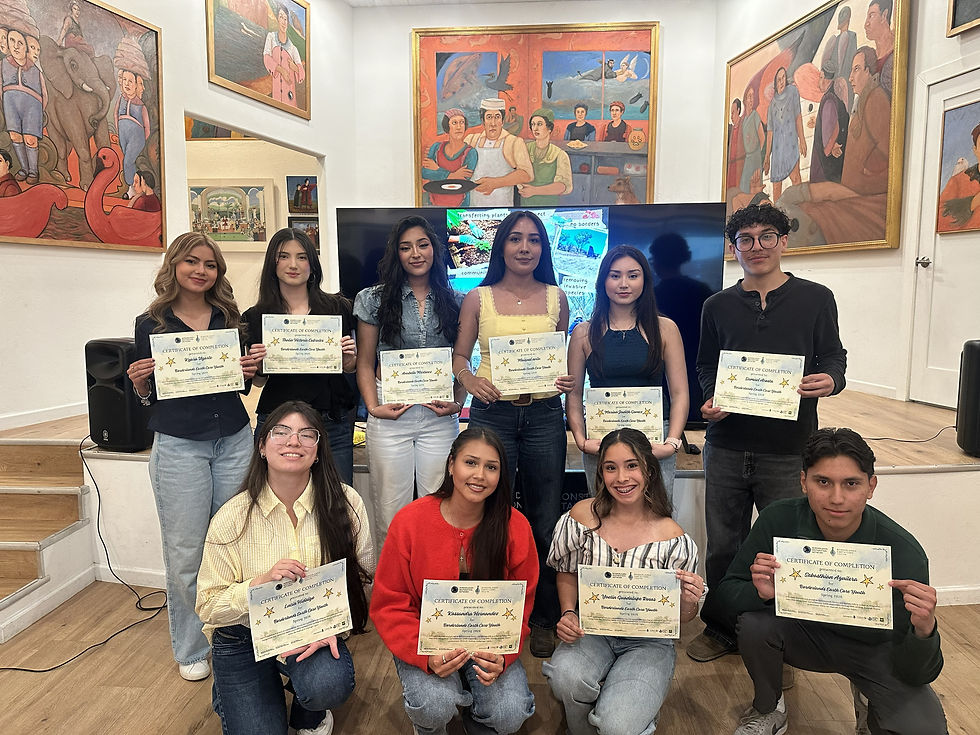
The week-long experience culminated at the Wittner Museum in Nogales where the cohort and their loved ones joined BRN and partners for a celebration. One by one, each of the BECY students shared their personal experience with the program.
They spoke about the indispensable importance of watershed health, ecology, and community. They also shared how their own lived experience as border locals have shaped their interest and passions.
This was truly a gratifying experience for everyone involved. This cohort added ten new alumni to the BECY program and the education team is excited to facilitate another cohort this upcoming fall for Cochise Country youth!


